












Air fryers get sold on one claim — healthier fried food — and questioned on another: that they are somehow harmful. Both deserve a straight answer. Here is what an air fryer genuinely improves, what it does not, and what the concerns actually amount to when you look at them properly.
Is an air fryer actually healthier?
Yes — but for one specific, unglamorous reason: it uses dramatically less oil. Deep frying submerges food; air frying needs a teaspoon or a light spray. Since oil is roughly 900 calories per 100 ml and fried food absorbs a meaningful amount of it, cutting the oil cuts the calories and the fat.
That is the entire health claim, and it is a real one. What an air fryer does not do is make unhealthy food healthy. Air-fried samosas are still samosas. Frozen nuggets are still processed food. The appliance changes the cooking method, not the ingredients.
The real disadvantages
These are the ones that actually affect daily use, in rough order of how often people complain about them.
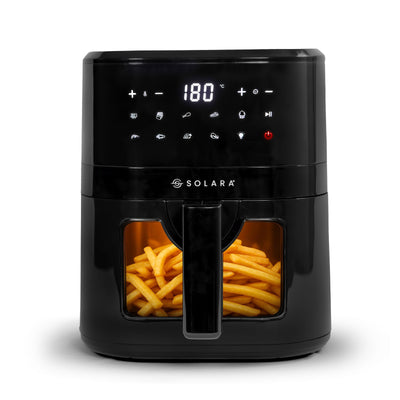
- Capacity is smaller than the number suggests. Food has to sit in roughly a single layer to crisp. A 4.5 litre basket realistically feeds two to four, not the six the box photo implies. Overfill it and you get steamed, pale food.
- Batch cooking. Following from the above — feeding a larger family often means two or three rounds.
- It is not silent. The fan is what does the work, and you can hear it.
- Lean food dries out. Chicken breast, paneer and fish need a light oil coat or they go leathery. The machine removes surface moisture very efficiently; that is the point, and also the risk.
- Texture is close, not identical. Air-fried food is crisp, but it is not deep-fried. Anyone expecting an exact match will be mildly disappointed.
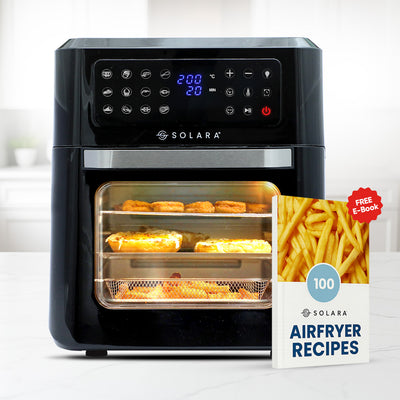
- Baking is limited. Tall cakes and breads do not do well in a small basket. That is a job for an OTG or an air fryer oven.
- Counter space. It is a permanent resident. An appliance stored in a cupboard gets used twice.
- A new-unit smell. Most units give off a slight plastic smell for the first couple of uses. Run it empty at high heat for ten minutes before cooking.
The acrylamide question
This is the concern behind most of the “is an air fryer harmful” searches, so it is worth being precise.
Acrylamide is a compound that forms in starchy foods cooked at high temperatures — potatoes and grains in particular. It forms when you deep fry, roast, bake, grill or toast. It is not created by air fryers specifically; it is created by dry heat above roughly 120 °C, whatever produces that heat. Toast has it. Roasted potatoes have it. Deep-fried chips have it, generally in larger amounts.
So the accurate statement is: air frying does not introduce a new risk, and for potatoes it typically produces less acrylamide than deep frying, because there is less oil and often less time at temperature. If you want to reduce it further, the standard advice applies to every cooking method:
- Cook to golden, not dark brown. Colour tracks acrylamide closely.
- Soak cut potatoes in water for 15–30 minutes before cooking, then pat dry.
- Store potatoes somewhere cool but not in the fridge — refrigeration raises their sugar content, which raises acrylamide.
There is no credible evidence that using an air fryer causes cancer. Treat any page claiming otherwise with suspicion.
Do basket coatings matter?
A fair question, and one worth asking of any brand. Most air fryer baskets are non-stick coated so food releases and cleanup is quick. The two things that actually matter:
- What the coating is. Ask the brand directly, and look for a stated specification rather than a vague “non-toxic” badge. SOLARA states a ceramic-coated basket that is PFOA-free and PFAS-free.
- Whether it stays intact. This is the part you control. Do not use metal tongs or knives in the basket, do not scour it, and replace the basket if the coating is visibly damaged. Paper liners and silicone baskets protect the surface and cut cleaning down to a wipe.
Who should not buy an air fryer
- People who rarely fry. If your cooking is mostly curries, dal and rice, an air fryer will sit unused. A pressure cooker or good cast iron will change your kitchen more.
- Serious bakers. Buy an OTG.
- Large families wanting one-shot cooking. A small basket will annoy you daily — size up to a 10L+ air fryer oven instead.
- Anyone with no spare counter space. Be honest about this one.
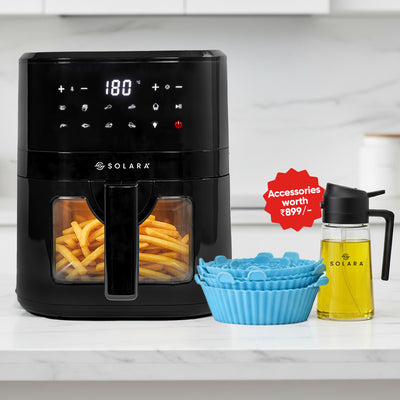
If it is the right fit — the 4.5L digital air fryer suits 2–4 people, and the 12L air fryer oven adds baking, grilling and rotisserie for larger households.
Frequently asked questions
Is an air fryer good or bad for health?
Good, relative to deep frying, because it uses far less oil. Neutral relative to baking or grilling, which are also dry-heat methods. It does not make unhealthy ingredients healthy.
Are air fryers harmful?
There is no credible evidence that air fryers are harmful. The acrylamide concern applies to all high-temperature dry cooking, not to air fryers specifically, and air frying starchy food typically produces less of it than deep frying.
What are the main disadvantages of an air fryer?
Limited usable capacity, batch cooking for bigger families, fan noise, a tendency to dry out lean foods, weak baking performance, and permanent counter space.
Does an air fryer really use 85% less oil?
Compared with deep frying, the reduction is dramatic — a spray or a teaspoon instead of a panful. The exact percentage depends entirely on what you are cooking and how much oil you would otherwise have used.
Can I use an air fryer every day?
Yes. It is a cooking appliance like any other. Daily use is fine; the sensible caution is about what you cook in it, not how often.
Do air fryers use a lot of electricity?
Less than most people expect, because the cooking times are short. There is a full working calculation in air fryer electricity consumption in India.
