







The most common reason people give up on stainless steel cookware is that everything sticks to it. It is also the most fixable problem in the kitchen, because sticking is almost never the pan — it is the timing. Get one sequence right and steel behaves.
Why food sticks to stainless steel
Steel looks smooth but is covered in microscopic pores. When the pan is cold or barely warm, those pores are open — food proteins settle into them and bond as they cook. That is the grip you feel when you try to move a piece of paneer and it tears.
Heat the pan properly first and the metal expands, the pores close, and a thin layer of oil sits on a much flatter surface. Food then sits on the oil rather than in the metal. The whole trick is doing this in the right order: heat the pan, then add oil, then add food. Most people add all three at once, which is why it goes wrong.
The water drop test (mercury ball test)
This is how you know the pan is ready. It takes ten seconds and removes all the guesswork.
- Heat the dry pan on medium for 2–3 minutes.
- Flick a few drops of water in.
- Drops sizzle and evaporate immediately — too cool. Keep heating.
- Drops form one or two silvery balls that glide across the surface like mercury — this is it. The pan is at the right temperature.
- Drops scatter into many tiny beads that skitter and vanish — too hot. Take it off the heat for thirty seconds.
That gliding-ball stage is the Leidenfrost point. Add your oil there, swirl it, and add food straight away.
The method, step by step
- Dry pan on medium. Not high. High heat scorches oil and creates the sticky brown film people mistake for damage.
- Water test until you get the gliding ball.
- Add oil and swirl to coat. It should shimmer and thin out within a couple of seconds.
- Add food immediately. Do not let the oil sit and smoke.
- Then leave it alone. Food bonds to the pan while it cooks and releases on its own once a crust forms. If it grips, it is not ready — wait another 30 seconds and try again.
- Pat food dry first and let it come off the fridge chill. Wet, cold food drops the pan temperature instantly.
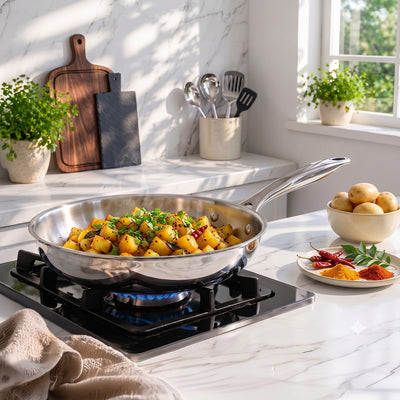
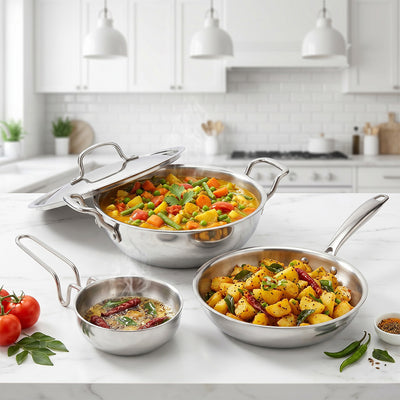
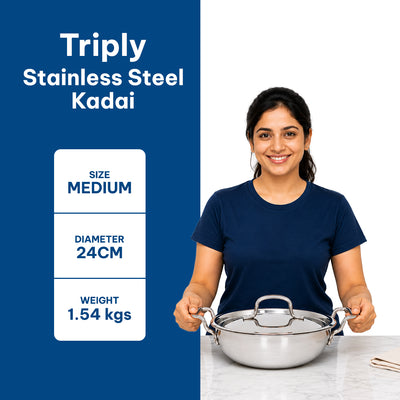
Triply makes all of this easier. SOLARA triply cookware bonds an aluminium core between two layers of SS 304, so heat spreads evenly instead of concentrating in a ring — no coating, nothing to wear out.
The foods people struggle with
Eggs
The hardest test. Heat to the water-ball stage, take the pan off the heat for about twenty seconds, add a generous amount of fat, then the egg, then return to low heat. Steel handles eggs well — it just wants more fat and lower heat than you expect.
Fish and paneer
Pat completely dry, salt just before it goes in, and do not touch it. Both release cleanly once a crust forms, usually two to three minutes. Moving them early is what tears them.
Dosa
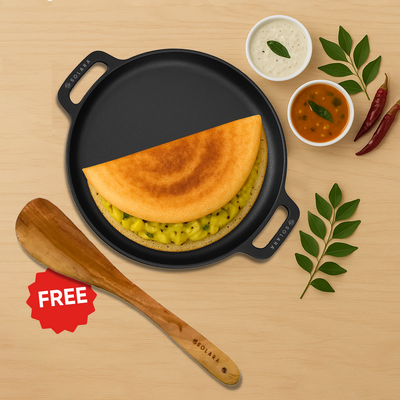
Steel is not the natural tool here — cast iron is, because its heat retention is what makes the edge crisp. If you do use steel, heat well, wipe with a cut onion and oil, and drop the heat before pouring the batter.
Onions and masala
Steel is excellent for this. The browned bits that stick are fond — concentrated flavour, not a mistake. Deglaze with a splash of water or tomato and scrape it back into the dish.
Cleaning the marks that put people off
| Mark | What it is | Fix |
|---|---|---|
| Brown sticky film | Polymerised oil, burnt on | Baking soda paste, or simmer water with a little vinegar, then scrub with a soft pad |
| White chalky patches | Mineral deposits from hard water | Simmer water with lemon juice or vinegar; wipes straight off |
| Rainbow tint | Harmless surface oxidation from heat | Wipe with vinegar. Cosmetic only — not damage |
| Burnt-on food | Overheating | Cover with water, simmer 10 minutes, then it lifts with a wooden spoon |
Steel takes abrasives far better than any coated pan, so none of this is fatal. Avoid steel wool on a mirror finish only because it dulls the shine, not because it harms the metal.
Frequently asked questions
Why does everything stick to my stainless steel pan?
The pan was not hot enough when the food went in, or the oil went in cold with the food. Heat the dry pan first, confirm with the water drop test, then add oil, then food.
Do you season stainless steel like cast iron?
No. Steel does not build a permanent seasoning layer, and it does not need one. Correct heat and enough oil do the same job every time you cook.
What are the disadvantages of stainless steel cookware?
It is not non-stick, it asks for technique, and it shows water marks. In exchange it is inert, has no coating to wear out, handles metal utensils and acidic food, and lasts far longer than any coated pan.
Is triply better than ordinary steel for sticking?
Yes, noticeably. Single-ply steel has an aluminium disc only in the base, so heat climbs unevenly and the hot ring catches food. Triply carries the core through the whole body, so the surface heats uniformly.
How much oil do I need?
More than with non-stick, less than deep frying. Enough to coat the base in a thin, mobile film. Cooking bone-dry on steel will stick regardless of technique.
Can I use metal utensils?
Yes. There is no coating to damage — one of the practical advantages of steel over ceramic and non-stick.
