






Ask which pressure cooker to buy and the conversation quickly becomes an argument about metal. Aluminium, hard-anodised or stainless steel? Each has a real case, and the marketing around all three is noisy. Here is what actually separates them.
The short answer
For most Indian kitchens, triply stainless steel is the best all-round choice: it is non-reactive with tomato and tamarind, has no coating that can wear off, works on induction, and lasts long enough to be cheaper per year than repeatedly replacing a budget cooker. Aluminium is the right answer only if the lowest possible upfront price is the deciding factor.
Full comparison table
| Plain aluminium | Hard-anodised | Triply stainless steel | |
|---|---|---|---|
| What touches food | Bare aluminium | Anodised aluminium oxide layer | SS 304 stainless steel |
| Reacts with acidic food | Yes | No, while the layer is intact | No |
| Surface that can wear or chip | No coating, but pits over time | Yes — the anodised layer | No |
| Induction compatible | Usually not | Only if a steel base is added | Yes |
| Heat distribution | Excellent | Very good | Very good — aluminium core does the work |
| Weight | Lightest | Medium | Heaviest |
| Dishwasher | No — discolours | Generally not recommended | Usually fine |
| Typical price (3L, India) | ₹800–₹1,600 | ₹1,500–₹3,000 | ₹2,500–₹4,500 |
| Realistic lifespan | 2–5 years | 4–8 years | 10+ years |
Aluminium: cheap, light, reactive
Aluminium conducts heat superbly and costs very little, which is why it dominated Indian kitchens for decades. Its weakness is chemistry: aluminium is reactive. Acidic ingredients — tomato, tamarind, lemon, kokum, vinegar — slowly etch the surface. Over time you see dulling and pitting, and dishes can pick up a faint metallic edge. It also dents easily and, in most cases, will not work on an induction hob at all.
Hard-anodised: a surface, not a metal
Hard anodising passes aluminium through an electrochemical bath to grow a hard, non-reactive oxide layer on its surface. The result genuinely is tougher and non-reactive — while the layer holds.
The catch is that it is still a surface treatment on aluminium. Metal spoons, scouring pads and dishwashers wear it down, and once it chips you are cooking on bare aluminium again with no way to restore it. Most hard-anodised cookers are also not induction compatible unless the maker has bonded a separate steel disc to the base.
Stainless steel and triply
Plain stainless steel is inert and durable but a poor heat conductor on its own — a single-ply steel cooker develops hot spots and scorches at the base. Manufacturers solve this in two ways.
- Sandwich (encapsulated) base — a disc of aluminium is bonded only to the bottom. Cheaper, but the walls stay poor conductors, so heat climbs unevenly.
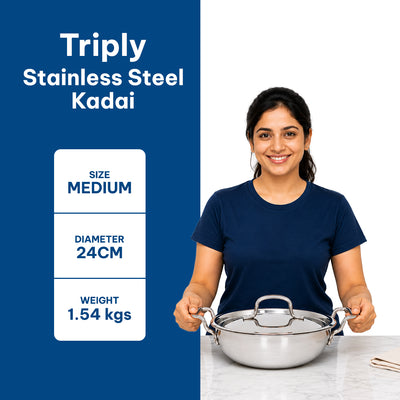
- Triply (tri-ply) — three layers are bonded across the entire body: SS 304 inside, aluminium in the middle, stainless steel outside. Heat spreads through the walls as well as the base.
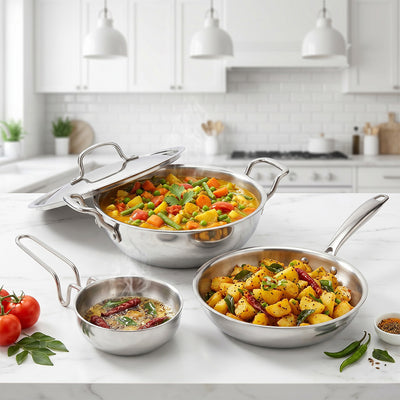
Triply gives you the conductivity of aluminium with the inertness of steel, and the aluminium is fully enclosed so it never touches food. There is no coating to chip, and the magnetic outer layer means it works on induction, gas, electric, ceramic and halogen. More detail in what is a triply pressure cooker.
Which pressure cooker metal is best for health?
Food-grade SS 304 stainless steel. It is non-reactive, so it will not interact with acidic food; it carries no non-stick coating, so there is no PTFE layer that can degrade at high heat and no PFOA (which cookware manufacturers phased out years ago but which still worries buyers); and it does not need seasoning or special utensils to stay safe.
That is a modest, defensible claim rather than a dramatic one — and it is the accurate one. The strongest argument for steel is not that other metals are dangerous, but that steel is inert and predictable: what you cook in it on day one is what you cook in it in year ten.
Cost per year, not cost per cooker
A ₹1,200 aluminium cooker replaced every three years costs about ₹400 a year. A ₹2,899 triply cooker that lasts ten costs about ₹290 a year — and you are not throwing a cooker away every few years. The cheaper cooker is only cheaper for the first three years.
Ready to switch to steel? The SOLARA triply range is SS 304 throughout, induction ready and available in 2L, 3L and 5L from ₹2,599.
Frequently asked questions
Are stainless steel pressure cookers safe?
Yes. Food-grade SS 304 is inert, non-reactive and used throughout commercial kitchens and food processing. It has no coating to break down and does not leach into acidic food.
Which is better, an aluminium or stainless steel pressure cooker?
Stainless steel, for almost every criterion except upfront price and weight: it resists acidic food, works on induction, does not pit, and lasts far longer. Aluminium wins on price and on being light to lift.
What are the disadvantages of a stainless steel pressure cooker?
It costs more upfront, it is heavier, and food can stick if you add ingredients to a cold pan. Preheat the cooker, add oil, then add food — sticking largely disappears.
Is triply better than a normal stainless steel cooker?
Yes, for heat distribution. A single-ply steel cooker with a sandwich bottom heats unevenly up the walls; triply bonds aluminium through the whole body, so the heat spreads instead of concentrating in a ring above the flame.
Is hard-anodised better than stainless steel?
Hard-anodised is non-reactive and tough while its surface layer is intact, but that layer can chip and cannot be repaired, and it is often not induction compatible. Stainless steel has nothing to chip.
Does food stick more in a stainless steel pressure cooker?
Only if it goes in cold. Heat the cooker first, add oil and let it shimmer, then add your ingredients. A triply base helps here too, because it heats evenly instead of creating a hot spot that catches the masala.
