







The number printed on a pressure cooker is its total volume, not its usable volume. That single fact explains most size regret. Fill rules mean a 3 litre cooker gives you roughly 2 litres of working space — and only about 1.5 litres for dal or rice. This guide translates litres into people, rice and dishes.
Start with the two-thirds rule
Every pressure cooker needs empty headroom above the food so steam can collect and the vent stays clear.
- Maximum two-thirds full for most foods — vegetables, meat, potatoes.
- Maximum half full for anything that foams or expands: dal, rice, pasta, legumes.
- Never less than about 1 cup of liquid, or the cooker cannot generate steam.
What size pressure cooker for how many people?
| Capacity | People | Usable (2/3) | Best suited to |
|---|---|---|---|
| 2 litre | 1–2 | ~1.3 L | Couples, bachelors, hostel and PG cooking, one dish at a time |
| 3 litre | 2–5 | ~2 L | The default family cooker — daily dal, rice, vegetables |
| 5 litre | 3–7 | ~3.3 L | Joint families, batch cooking, biryani, chole, guests |
Family of 2
A 2 litre cooker is enough for daily dal and rice, and it comes to pressure quickly, which matters when you are cooking small quantities twice a day. Choose 3 litre instead if you batch-cook on weekends or host often.
Family of 4
A 3 litre cooker is the right default. It handles dal for four, rice for four, and a full sabzi comfortably. If you regularly cook rajma, chole or biryani for the whole family in one go, step up to 5 litre.
Family of 5 to 6
Go 5 litre. A 3 litre will technically feed five, but you will be cooking at its limit every day, which means more spillover through the vent and more careful watching. Many families of this size keep a 5 litre for dal and rice and a 2 or 3 litre for a second dish running in parallel.
Family of 7 or more
A 5 litre plus a second cooker or a pressure pan beats one very large cooker. Two vessels cook two dishes at once, which is the actual bottleneck at that scale — not capacity.
How much rice and dal does each size hold?
Rice roughly triples in volume as it cooks, so the half-full rule matters here more than anywhere.
| Cooker | Raw rice (max) | Cooked rice, approx | Raw dal (max) |
|---|---|---|---|
| 2 litre | ~1 cup (200 g) | Serves 2–3 | ~3/4 cup |
| 3 litre | ~1.5 cups (300 g) | Serves 4–5 | ~1 cup |
| 5 litre | ~2.5 cups (500 g) | Serves 7–8 | ~1.5–2 cups |
These are safe working maximums, not absolute limits — stay under them and the vent stays clear.
Sizing a pressure pan
A pressure pan is wide and shallow, so a 2 litre pan holds noticeably less usable food than a 2 litre cooker. Size it by dish rather than by litre: a 2 litre pan makes sabzi for 2–3 people, a 3 litre pan makes a full curry for 3–5. If you are unsure whether you want a pan at all, read pressure pan vs pressure cooker.
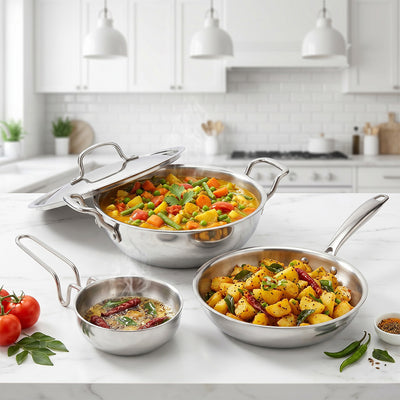
Still deciding? The SOLARA triply range covers 2L, 3L and 5L cookers plus 2L and 3L pans, so you can mix sizes in one combo.
How many whistles? A chart for common dishes
Whistle counts vary with flame, altitude, soaking and how soft you like things. Treat these as starting points and adjust once, then repeat.
| Dish | Whistles | Notes |
|---|---|---|
| White rice | 2–3 | Soak 15 minutes; 1:2 rice to water |
| Brown rice | 4–5 | Soak 30 minutes; more water |
| Toor / moong dal | 3–4 | No soaking needed |
| Chana dal | 5–6 | Soak 30 minutes for a softer finish |
| Whole masoor | 4–5 | — |
| Rajma | 6–8 | Soak overnight, else far longer |
| Chole / chickpeas | 6–8 | Soak overnight |
| Potatoes, whole medium | 3–4 | Natural release for firm potatoes |
| Chicken curry | 2–3 | Overcooking dries the meat |
| Mutton | 8–10 | Or about 20 minutes at pressure |
| Biryani, layered | 1–2 | On low flame, after layering |
| Idli / dhokla | 0 | Steam with the weight off |
A triply base helps consistency here: because heat spreads through the walls rather than concentrating in a ring above the burner, the same dish takes the same number of whistles batch after batch.
Frequently asked questions
Is a 3 litre pressure cooker enough for a family of 4?
Yes, for everyday dal, rice and vegetables. Move to 5 litre if you often cook rajma, chole or biryani for all four in a single batch.
A 2 litre pressure cooker is for how many persons?
One to two people. It is the right size for a couple, a bachelor kitchen or a hostel room, and it reaches pressure quickly.
How much rice can I cook in a 5 litre pressure cooker?
About 2.5 cups (roughly 500 g) of raw rice, which serves 7–8 people. Keep the cooker no more than half full, because rice foams and expands.
Which size pressure cooker is most useful overall?
3 litre. It is large enough for a family of four and small enough to come to pressure quickly for a daily dal, which is why it outsells every other size in India.
Can I cook a small quantity in a large pressure cooker?
Yes, as long as you keep at least a cup of liquid in it. The only cost is a slightly longer time to reach pressure.
Should I buy two small cookers or one large one?
If you cook multiple dishes at once, two vessels save more time than one big one. A common setup is a 3L or 5L cooker for dal and rice plus a pressure pan for the sabzi, which is exactly what the cooker + pan combo is built for.
