






If you are searching for the best pressure cooker in India, the honest answer is that there is no single winner — there is only the right cooker for your family size, your cooktop, your cooking style and your budget. This guide walks through the six decisions that actually matter, so you can choose confidently instead of guessing between a hundred near-identical listings.
1. Which metal is best for a pressure cooker?
This is the single most important decision, because it determines what touches your food every day. In the Indian market you will mostly see three options.
| Type | Reacts with acidic food? | Coating that can wear off? | Induction ready | Best for |
|---|---|---|---|---|
|
Triply stainless steel (SS 304 / aluminium / SS) |
No — SS 304 is non-reactive | None | Yes | Daily cooking, tomato and tamarind gravies, long-term buy |
| Plain aluminium | Yes — reacts with tomato, tamarind, lemon | None | Usually not | Lowest upfront price |
| Hard-anodised | No, while the layer is intact | Yes — the anodised surface can chip | Not always | Mid-range, careful users |
Plain aluminium is cheap and light, and it is what most Indian kitchens grew up with. The trade-off is that bare aluminium is reactive: acidic foods like tomato, tamarind and lemon can pit the surface and leave a faint metallic edge in the taste. Hard-anodised cookers solve the reactivity problem with a hardened surface layer, but that layer is still a surface — once it chips, you are back to bare metal.
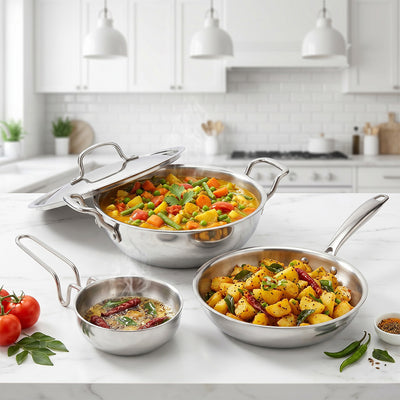
Triply (or tri-ply) stainless steel takes a different approach. Instead of coating the metal, it bonds three layers together: a food-grade SS 304 inner surface, an aluminium core that spreads heat, and a stainless steel outer that works on induction. There is no coating to wear off and nothing reactive touching your food, which is why triply has become the default recommendation for anyone buying a cooker they intend to keep for years. The full comparison is in stainless steel vs aluminium vs hard-anodised.
2. What size pressure cooker do you need?
Undersizing is the most common regret. A cooker should never be filled more than two-thirds full — and only half full for foods that foam, like dal and rice — so a 3 litre cooker really gives you about 2 litres of usable space.
| Capacity | Suits | Typical use |
|---|---|---|
| 2 litre | 1–2 people | Couples, bachelors, hostel and office cooking, small dal or rice batches |
| 3 litre | 2–5 people | The everyday all-rounder for most Indian families |
| 5 litre | 3–7 people | Joint families, batch cooking, biryani, chole, weekend guests |
If you are between two sizes, go up. A larger cooker can cook a small quantity; a small cooker cannot cook a large one. The full breakdown, including how much rice each size actually holds, is in the pressure cooker size guide.
3. Outer lid vs inner lid
Both are safe when well made — they simply seal in opposite directions.
- Outer lid cookers close over the rim. They are easier to open and close, easier to clean around the rim, and give you a wider mouth for filling and serving. Most stainless steel and triply cookers use this design.
- Inner lid cookers drop inside the rim and are held shut by the pressure itself, which some buyers prefer as an extra safety cue. They usually have a narrower mouth.
For everyday Indian cooking — lifting the lid to check dal, adding a tadka, serving straight from the cooker — an outer lid is generally the more convenient choice.
4. Will it work on your cooktop?
If you own an induction hob, or might buy one, check the base before anything else. Induction needs a magnetic base; a plain aluminium cooker will simply not heat up on it. A triply stainless steel pressure cooker has a flat, magnetic, heat-spreading base that works across induction, gas, electric, ceramic and halogen cooktops, so it survives a kitchen upgrade.
5. Best pressure cooker by budget
Prices in India span a very wide range, and what you get changes sharply at each step.
- Under ₹1,000 — almost always plain aluminium, inner lid, no induction base. Fine as a spare; not a long-term buy.
- ₹1,000–₹2,000 — better aluminium cookers and some entry stainless steel. Check carefully whether the stainless steel is single-ply with a sandwich bottom or genuinely triply throughout.
- ₹2,000–₹3,000 — the sweet spot. Real triply stainless steel starts here. The SOLARA triply pressure cooker sits in this band at ₹2,599 for 2L and ₹2,899 for 3L.
- ₹3,000–₹5,000 — larger triply capacities and premium finishes; 5L triply lands around ₹3,799.
- Above ₹5,000 — usually multi-piece sets. A cooker + pan combo from ₹4,999 covers two cooking jobs for less than two separate pieces.
Budget-specific picks are in best pressure cooker under ₹3,000.
6. Safety features worth checking
- Safety valve — a secondary release that vents if the main whistle blocks. Non-negotiable.
- Gasket quality — nitrile rubber gaskets hold their seal longer. Plan to replace the gasket every 12–18 months regardless of brand.
- Spare parts availability — gaskets, whistles and safety valves are consumables. A cooker whose spares you cannot buy is a cooker with an expiry date.
- Handle design — heat-resistant, firmly fixed handles that stay cool and give a secure grip when the cooker is full and heavy.
- Warranty — read what it covers. Body warranties are common; gasket and whistle wear is normally excluded everywhere.
Looking for a triply cooker that ticks all six boxes? The SOLARA triply range is SS 304 inside, induction ready, outer lid, and available in 2L, 3L and 5L — with a cooker + pan combo if you want both.
Frequently asked questions
Which pressure cooker is best for health?
A triply stainless steel cooker with an SS 304 inner surface. SS 304 is non-reactive and carries no non-stick coating, so nothing leaches into acidic foods and there is no PFOA or PTFE layer that can break down at high heat.
Which metal is best for a pressure cooker?
Stainless steel — specifically triply construction, which bonds stainless steel around an aluminium core. You get the non-reactive safety of steel with the even heat conduction of aluminium, without the aluminium ever touching your food.
Is a stainless steel pressure cooker better than aluminium?
For durability, food safety and induction compatibility, yes. Aluminium wins only on upfront price and weight. Over a five to ten year horizon a triply steel cooker usually works out cheaper per year of use.
What size pressure cooker is best for a family of 4?
A 3 litre cooker handles daily dal, rice and vegetables for four people. If you regularly cook biryani, chole or batch meals, a 5 litre gives you far more headroom.
Is a triply pressure cooker good?
For most households it is the best balance available. It heats evenly, will not react with tomato or tamarind, works on every cooktop including induction, and has no coating that can chip. The trade-offs are a higher upfront price and a little more weight than aluminium.
How many whistles does dal need?
Toor and moong dal typically need 3–4 whistles, chana dal 5–6, and rajma or chole 6–8 after soaking. A triply base heats more evenly, so times stay consistent batch to batch. There is a full chart in the size and cooking time guide.
Keep reading
- What is a triply pressure cooker? Meaning, benefits and whether it is worth it
- Stainless steel vs aluminium vs hard-anodised pressure cooker
- Pressure pan vs pressure cooker — what is a pressure pan?
- Pressure cooker size guide: 2L, 3L or 5L?
- Best pressure cooker under ₹3,000
- Shop the SOLARA triply pressure cooker range
