








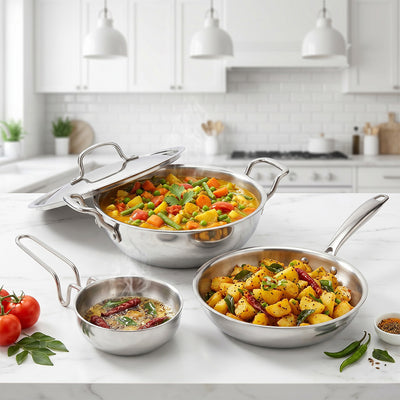
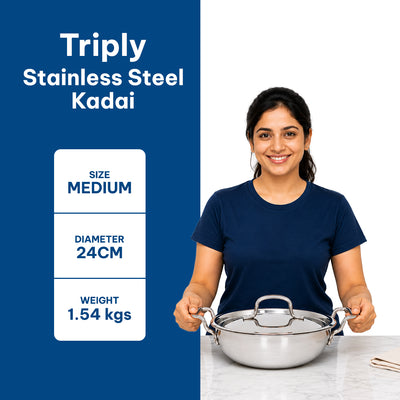
Triply — also written tri-ply or 3-ply — describes how the metal of a cooker is built, not what has been sprayed onto it. Three sheets of metal are bonded together into a single wall: food-grade SS 304 stainless steel on the inside, a layer of aluminium in the middle, and stainless steel on the outside. The name is literal: three plies of metal.
Why three layers instead of one?
Because the two properties you want in a cooker live in different metals.
- Stainless steel is inert but conducts heat poorly. It will not react with tomato or tamarind, but on its own it develops hot spots — a burning ring right above the flame while the rest of the base stays cooler.
- Aluminium conducts heat beautifully but is reactive. It spreads heat evenly, but acidic food etches it and it will not work on induction.
Triply resolves the conflict by putting aluminium where it helps and steel where it matters. The aluminium core spreads heat across the entire body — walls included, not just the base — while the SS 304 inner layer is the only thing your food ever touches. The aluminium is fully sealed between two sheets of steel, so it never contacts food and never needs to.
Triply vs a normal stainless steel cooker
This is the comparison that actually matters when you are shopping, because most cookers sold as stainless steel are not triply.
| Single-ply steel with sandwich base | Triply | |
|---|---|---|
| Construction | Aluminium disc bonded to the bottom only | Three layers bonded through the whole body |
| Heat up the walls | Poor — walls are thin single-ply steel | Even — the core runs up the sides |
| Hot spots | Common, especially on a small burner | Rare |
| Sticking and scorching | More likely at the base | Less likely |
| Weight | Lighter | Heavier |
| Price | Lower | Higher |
For boiling dal, the difference is modest. For anything where you brown masala first, or where a thick gravy sits against the wall, it is very noticeable.
Is a triply pressure cooker good or bad?
Good, with two honest caveats.
What it does well: even heating with no hot spots; a completely non-reactive SS 304 cooking surface; no coating that can chip or wear off; works on induction as well as gas, electric, ceramic and halogen; and a realistic lifespan measured in a decade rather than a few years.
The trade-offs: it costs more upfront than aluminium, and it is heavier — a full 5 litre triply cooker is a meaningful lift. If a light cooker matters more to you than durability, aluminium is a legitimate choice. The metal comparison is laid out fully in stainless steel vs aluminium vs hard-anodised.
Outer lid vs inner lid
Most triply cookers use an outer lid, which closes over the rim. It gives a wider mouth, so filling, stirring and serving are easier, and there is no narrow lip to scrub. Inner lid cookers drop inside the rim and are held shut by internal pressure, which some buyers find reassuring, but the narrower opening makes them fiddlier for everyday cooking.
Both designs are safe when they include a working safety valve. Choose on convenience, not on fear.
How to spot a genuine triply cooker
- Look at the rim. On a real triply body you can often see three distinct bands in the cut edge — steel, a lighter aluminium line, steel.
- Check the wall, not just the base. If the thickness is only in the bottom disc, it is a sandwich base, not triply.
- Read the listing literally. Terms like heavy-gauge, premium steel or induction bottom do not mean triply. The words triply, tri-ply or 3-ply should appear.
- Check the inner grade. SS 304 is the food-grade standard you want on the inside.
- Magnet test. A triply cooker has a magnetic steel outer, so a fridge magnet grips the base firmly — which is also how you know it will work on induction.
SOLARA triply pressure cookers are SS 304 inside, triply through the body, outer lid, and induction ready — in 2L, 3L and 5L, with a pressure pan and a cooker + pan combo alongside.
Caring for a triply pressure cooker
- Preheat before adding food. Heat the cooker, add oil, wait for it to shimmer, then add ingredients. This is the single biggest reason food sticks to steel — not the steel itself.
- Deal with white marks. Chalky patches are mineral deposits from hard water. Simmer a little water with lemon juice or vinegar and they lift off.
- Rainbow tint is harmless. A faint iridescent sheen is oxidation, not damage. A vinegar wipe removes it.
- Skip steel wool. A soft sponge with mild dish soap is enough; abrasives leave scratches that catch food later.
- Replace the gasket every 12–18 months. Gaskets are consumables on every brand and every metal. A cooker that struggles to hold pressure usually needs a gasket, not repair.
- Dry the base. Standing water on any steel base can leave spots over time.
Frequently asked questions
What does triply mean in a pressure cooker?
It means the body is made of three bonded layers of metal: SS 304 stainless steel inside, an aluminium heat core in the middle, and stainless steel outside. It refers to construction, not to any coating.
Is triply better than normal stainless steel?
For heat distribution, yes. A normal steel cooker usually has an aluminium disc only in the base, so the walls heat unevenly. Triply carries the core through the whole body.
Is a triply pressure cooker worth the extra money?
If you cook daily and expect the cooker to last, yes — the higher price spreads over roughly ten years of use rather than three. If you need a cheap spare cooker, it is not.
Is a triply pressure cooker induction compatible?
Yes. The outer layer is magnetic stainless steel, so it works on induction as well as gas, electric, ceramic and halogen cooktops.
Is a triply pressure cooker dishwasher safe?
The body generally is, but hand washing is gentler and keeps the finish bright longer. Wash the gasket and the lid by hand, and never put the gasket through a hot cycle.
Does food stick in a triply cooker?
Only if it goes into a cold pan. Preheat, add oil, then add food. Triply actually sticks less than single-ply steel, because there is no concentrated hot spot to catch the masala.
What is the difference between triply and 5-ply?
More layers usually means more aluminium or copper for heat capacity, and more weight and cost. For pressure cooking — where steam, not sear, does the work — triply is the practical sweet spot.
