






Walk into any Indian kitchen shop and you will be offered two things that look almost the same: a pressure cooker and a pressure pan. They use identical technology — a sealed lid, a gasket, a weight valve — but their shape changes what they are good at. Here is the difference in plain terms, and how to decide which one you actually need.
What is a pressure pan?
A pressure pan is a pressure cooker with a wide, shallow body instead of a tall, deep one. Same gasket, same safety valve, same whistle — but because the base is broader and the walls are lower, it behaves much more like a kadai or a saucepan that happens to build pressure.
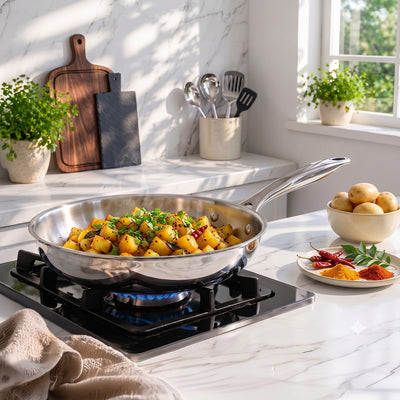
That wider base is the whole point. It gives you more surface area in contact with the flame, which means you can genuinely sauté and brown onions, ginger-garlic and masala directly in the pan before you seal the lid — something that is awkward in the narrow well of a deep cooker. It also means the liquid spreads out, so gravies reduce and thicken instead of pooling at the bottom.
Pressure pan vs pressure cooker at a glance
| Pressure pan | Pressure cooker | |
|---|---|---|
| Shape | Wide and shallow | Tall and deep |
| Base area | Larger — better for sautéing and browning | Smaller — better for volume |
| Best for | Sabzi, dum dishes, shallow curries, sautéed masala, upma, poha, one-pan meals | Dal, rice, rajma, chole, biryani, stock, steaming |
| Handling | Easy to stir, easy to serve from, easy to clean | Deep well; a ladle reaches the bottom less easily |
| Typical capacity | 2–3 litres (usable volume is lower than a cooker of the same rating) | 2–5 litres and up |
| Foaming foods | Less suitable — less headroom above the food | Better — the depth contains froth from dal and rice |
| Storage | Stacks flat, fits a shelf | Taller, needs vertical space |
What a pressure pan is best for
- Sabzi and shallow curries — aloo gobi, bhindi masala, egg curry, chicken curry. Brown the masala, add the vegetables, seal, two whistles, done in one vessel.
- Dum cooking — the wide flat base gives an even layer, which is exactly what dum aloo and dum-style dishes want.
- Quick one-pan meals — upma, poha, pulao for two, khichdi. Everything from tadka to finish in a single pan.
- Reducing gravies — leave the lid off after pressure cooking and the wide surface evaporates liquid fast.
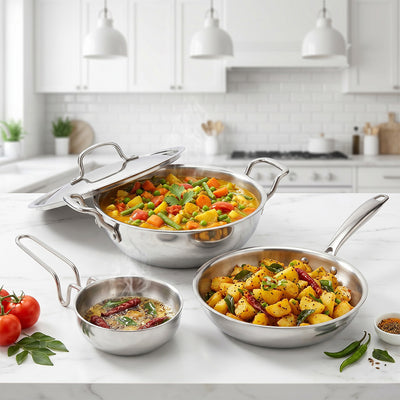
The SOLARA triply stainless steel pressure pan comes in 2L (2–3 people) and 3L (3–5 people), both with an SS 304 inner surface and an induction-ready triply base.
What a pressure cooker is best for
- Dal and rice — these foam heavily. The extra depth keeps froth well below the vent.
- Rajma, chole, chana — long-cooking legumes need volume for water plus expansion.
- Biryani and pulao in quantity — layering needs height.
- Steaming and stacking — separators let you cook dal and rice at the same time.
The SOLARA triply pressure cooker comes in 2L, 3L and 5L. If you are unsure which capacity fits your household, the pressure cooker size guide works through it by family size.
So which should you buy?
If you can only buy one, buy the pressure cooker. Dal and rice are daily, non-negotiable jobs in most Indian kitchens, and a deep cooker does them safely. A pressure pan cannot fully replace it, because foaming foods need headroom.
If you already own a cooker, the pan is the better second buy — far more useful than a second cooker of a different size, because it does a genuinely different job. Two vessels also means two dishes cooking in parallel, which is what actually shortens a weeknight dinner.
That is why most households end up with both. A cooker + pan combo pairs any cooker size (2L, 3L or 5L) with a 2L or 3L pan and works out cheaper than buying the two pieces separately.
Want both, without paying for both? The SOLARA Triply Pressure Duo lets you mix and match cooker and pan sizes in one order, from ₹4,999.
And what about a pressure handi?
A pressure handi sits between the two: rounded, belly-shaped, deeper than a pan but wider than a standard cooker. It is designed for slow, moist dishes — biryani, nihari, curries that benefit from a curved base. It is a specialist. For a first or second vessel, a cooker and a pan cover far more ground.
Frequently asked questions
Is a pressure pan better than a pressure cooker?
Neither is better overall — they suit different dishes. A pressure pan is better for sautéing, sabzi, dum dishes and shallow curries. A pressure cooker is better for dal, rice, legumes and anything cooked in quantity.
Can I cook rice and dal in a pressure pan?
In small quantities, yes, but keep it to no more than half full. Dal and rice foam as they cook, and a shallow pan gives that froth less room, which raises the risk of the vent clogging.
Does a pressure pan cook faster than a pressure cooker?
It reaches pressure slightly faster because there is less volume to heat and a wider base picking up the flame. Once at pressure, cooking times are broadly the same — pressure, not shape, does the work.
What is the difference between a pressure pan and a kadai?
A kadai is open and cooks at atmospheric pressure. A pressure pan seals and builds pressure, so the same dish cooks in a fraction of the time and stays moister.
Which size pressure pan should I buy?
A 2 litre pan suits 2–3 people and everyday sabzi. A 3 litre pan suits 3–5 people and lets you cook a full curry for the family in one go.
Are triply pressure pans worth it?
If you sauté in the pan — and that is the main reason to own one — then yes. A triply base spreads heat evenly across that wide bottom, so masala browns uniformly instead of scorching in a hot ring above the burner. More on the construction in what is a triply pressure cooker.
