







Most cookware advice online tries to crown one material. That is the wrong frame. Ceramic, cast iron, triply stainless steel and non-stick are four different tools, and a kitchen that cooks Indian food properly wants two or three of them — not four of the same pan. This guide sets out what each one is genuinely good at, and what it costs you.
The comparison at a glance
| Cast iron | Triply steel | Ceramic | Non-stick | |
|---|---|---|---|---|
| Coating | None | None | Silica coating | PTFE coating |
| Non-stick when new | Moderate, improves | Low | Excellent | Excellent |
| Non-stick in year 3 | Better than year 1 | Unchanged | Faded | Reduced |
| High-heat searing | Best | Very good | Avoid | Avoid |
| Acidic food (tomato, tamarind) | Once seasoned | Always fine | Fine | Fine |
| Metal utensils | Yes | Yes | No | No |
| Weight | Heavy | Medium | Light | Light |
| Realistic lifespan | Decades | 10+ years | 1–3 years of coating | 2–5 years of coating |
| Maintenance | Dry & oil it | Almost none | Gentle heat only | Gentle heat only |
Cast iron — heat retention and permanence
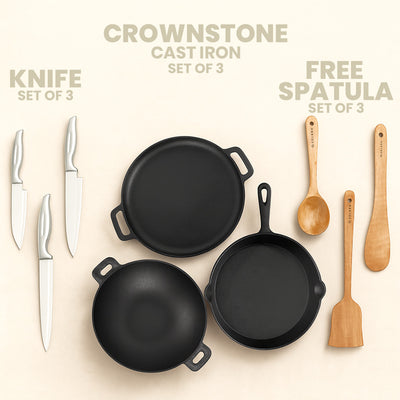
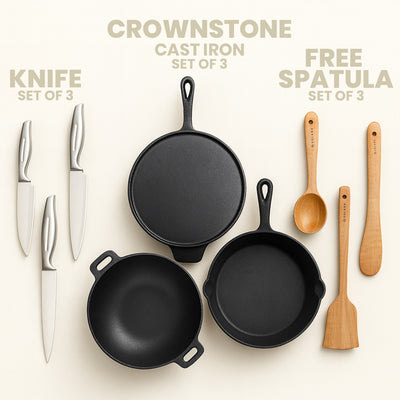
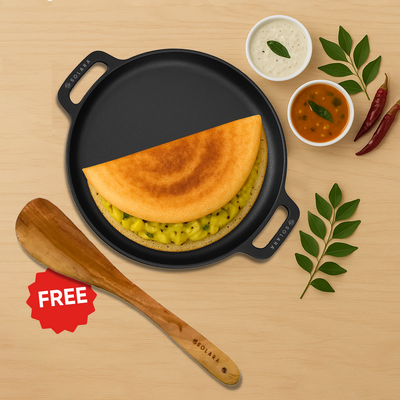
What it is best at: anything where the pan must stay hot when cold food hits it. Dosa, roti, deep frying, searing. Its mass means the surface temperature barely dips, which is exactly why a dosa crisps instead of steaming.
What it costs you: weight, and a small maintenance habit — dry it after washing, wipe a little oil on it. It rusts if you leave it wet. In exchange it is the only material here that gets better with use, because the seasoning layer builds up rather than wearing off.
Details in the cast iron guide, or shop the cast iron range.
Triply stainless steel — the low-maintenance workhorse
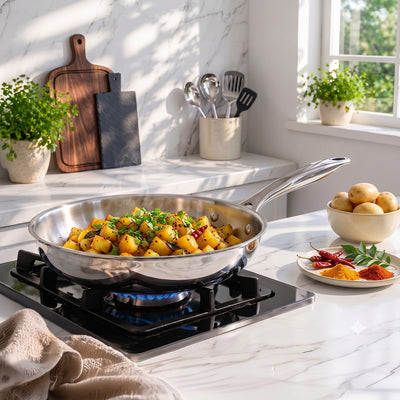
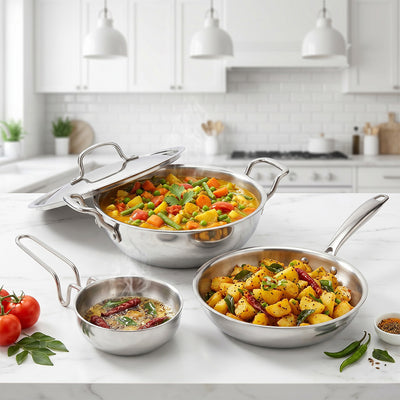
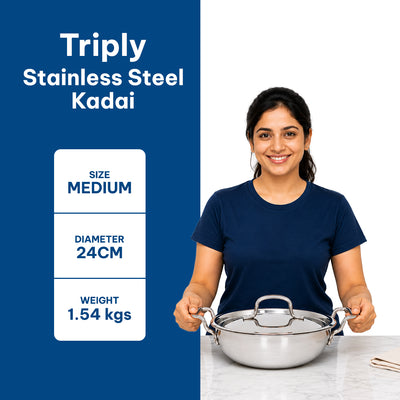
What it is best at: everything wet, everything acidic, and everything you want to forget about. Three bonded layers — SS 304 inside, aluminium core, steel outside — give even heat with a completely inert surface. No coating, no seasoning, no reactivity. Curries, dal, gravies, boiling, braising.
What it costs you: it is not non-stick, and it never will be. Food releases when you preheat properly and use enough oil, but it asks for technique rather than forgiving the lack of it. If you have ever been frustrated by steel, this fixes it.
More in the triply cookware guide, or shop triply cookware.
Ceramic — low-oil cooking, on a clock
What it is best at: eggs, dosa, fish, low-oil sabzi — anything delicate that you want to release cleanly with minimal fat. It is also the easiest of the four to clean, which is not a trivial point on a weeknight.
What it costs you: lifespan. A silica coating gradually loses slickness over roughly one to three years of regular use. Keep the heat low to medium, never preheat it empty, and it lasts a lot longer than average — but it is a pan with a service life, not a forever pan. The full picture is in is ceramic cookware safe?
Shop the Belmont ceramic range.
Classic non-stick (PTFE) — convenience with conditions
What it is best at: the same delicate, low-oil jobs as ceramic, and it holds its release a bit longer.
What it costs you: it is a fluoropolymer coating, which is precisely the chemistry a lot of buyers are now trying to move away from, and it must never be overheated or scratched. Once it starts flaking, the pan is finished.
Cost per year, not sticker price
Sticker price is the most misleading number in cookware. Coated pans are consumables; uncoated pans are not.
| Material | Typical spend | Replaced every | Roughly per year |
|---|---|---|---|
| Cast iron tawa | ~₹1,100 | Effectively never | Negligible after year one |
| Triply kadai | ~₹1,700 | 10+ years | ~₹170 |
| Ceramic fry pan | ~₹1,400 | ~2 years | ~₹700 |
| Budget non-stick | ~₹800 | ~2 years | ~₹400 |
What to actually buy
If you are building a kitchen from scratch, this order gets you the most capability for the least money:
- A cast iron tawa. Dosa, roti, paratha — the highest-frequency job in most Indian homes, and the one where cast iron wins outright. Cast iron tawa
- A kadai. Cast iron if you deep fry often and do not mind the weight; triply if you cook a lot of tomato and tamarind gravies and want zero maintenance.
- A ceramic fry pan. The one place a coating genuinely earns its keep — eggs and delicate things, with almost no oil. Ceramic fry pan 24cm
- A pressure cooker. Dal and rice, daily. Triply pressure cookers
- Then specialise — tadka pan, paniyaram pan, casserole.
Not sure where to start? Every SOLARA range is built around one of these materials, so you can pick by the job rather than by the brand.
Frequently asked questions
Which cookware material is healthiest?
Uncoated materials give you the fewest variables — triply stainless steel is inert and non-reactive, and cast iron has no coating at all. Ceramic is a reasonable coated option. The honest answer is that all four are fine in normal use; uncoated simply has less that can degrade.
Is ceramic better than cast iron?
For eggs and low-oil cooking on a weeknight, yes. For dosa, deep frying, searing and lasting twenty years, no. They are not really competing for the same slot.
Do I need triply if I already have cast iron?
Usually yes, for acidic and wet cooking. Cast iron handles tomato and tamarind fine once well seasoned, but triply handles it from day one with no maintenance, and it is far lighter to lift full.
Which is best for an induction cooktop?
Cast iron and triply both work natively — both are magnetic. For ceramic and non-stick, check that the specific pan has an induction-compatible base.
How many pans does a kitchen actually need?
Three or four, chosen for different jobs, beats eight of the same kind. A tawa, a kadai, one small non-stick or ceramic pan and a pressure cooker cover almost all Indian home cooking.
