









Almost every Indian kitchen already has a mixer grinder, so the honest question is not “which is best” — it is whether a cold press juicer does anything your mixer cannot. It does, but only for a specific kind of cooking. Here is where the line falls.
Juice vs smoothie: the difference that decides everything
A juicer separates. It pulls the liquid out and leaves the fibre behind as pulp. A mixer or blender combines — it pulverises everything, fibre included, into a thick drink.
Neither is objectively healthier. Juice gives you a concentrated hit of nutrients that is quicker to absorb and easier to drink in volume — useful if you want a glass of green juice you would never eat as a plate of spinach. A smoothie keeps the fibre, which slows sugar absorption and is more filling. Choose by what you want, not by which is marketed harder.
Full comparison
| Cold press juicer | Mixer grinder | Portable blender | |
|---|---|---|---|
| Output | Clear juice, fibre removed | Thick pulp or paste | Smoothie, fibre retained |
| Speed | Low RPM, crushes and presses | Very high RPM, shreds | High RPM, shreds |
| Heat & oxidation | Minimal | Noticeable | Noticeable |
| Leafy greens & wheatgrass | Handles well | Poor yield | Blends, does not juice |
| Ginger, turmeric, amla | Excellent | Needs straining | Needs straining |
| Masala, chutney, dry grinding | No | Best | No |
| Noise | Quiet | Loud | Moderate |
| Cleaning | Several parts, few minutes | Jar rinse | Rinse in the bottle |
| Typical price | Higher | Mid | Lowest |
What a mixer grinder does best
Everything a juicer cannot touch: masala, chutney, idli and dosa batter, dry spice grinding, coconut, wet grinding. It is the workhorse of the Indian kitchen and a juicer replaces exactly none of that. Anyone selling you a juicer as a mixer replacement is selling badly.
For fruit drinks, a mixer makes an excellent thick juice or milkshake — mango, banana, chikoo. If that is what you drink, you may genuinely not need anything else.
What a cold press juicer does best
The case for one is narrower but real:
- Leafy greens and wheatgrass. A mixer barely yields anything from spinach or wheatgrass; an auger presses it properly.
- Ginger, turmeric and amla shots. Fibrous, dense ingredients where straining a blended pulp is genuinely painful.
- Volume without bulk. A glass of carrot-beet-apple juice uses more produce than you would eat whole.
- Drier pulp, higher yield. Over months of daily juicing, less produce goes in the bin.
- Quiet. A mixer at 6am wakes the household. A slow juicer does not.
The trade-off is honest: it costs more, it takes a few minutes to clean, and it does one job. Cold press vs the fast centrifugal type is covered separately in cold press juicer or centrifugal juicer.
Where a portable blender fits
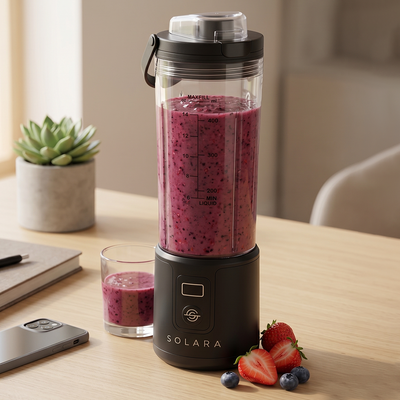
A portable blender is not competing with either. It is for smoothies and protein shakes made where you are — desk, gym, travel — blended in the bottle you drink from, with nothing to wash up. If your actual need is a post-workout shake rather than a glass of green juice, it is the cheaper and more useful buy by a wide margin.
So which should you buy?
- You want protein shakes and fruit smoothies. Portable blender. Do not spend juicer money.
- You want daily green juice, ginger shots or wheatgrass. Cold press juicer. Nothing else does it properly.
- You want thick fruit juice and milkshakes. Your mixer already does this.
- You want to grind masala. Mixer grinder, always.
- You are juicing to lose weight. Think twice — a smoothie keeps the fibre and will keep you fuller. Juice is a supplement to a diet, not a substitute for meals.
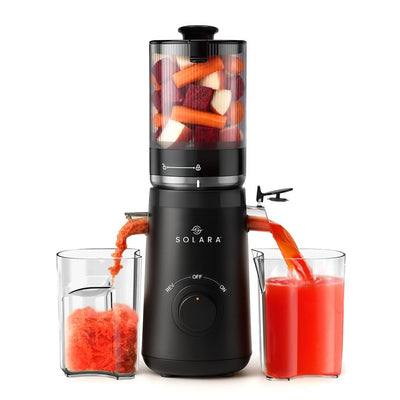
Decided on juice? The SOLARA Cold Press Juicer runs slow and quiet, handles leafy greens and ginger, and comes apart for cleaning in minutes.
Frequently asked questions
Can a mixer grinder replace a cold press juicer?
For soft fruit, largely yes — blend and strain. For leafy greens, wheatgrass, ginger and amla, no. The yield is poor and the straining is tedious enough that most people stop doing it.
Is cold press juice actually healthier?
It oxidises less and keeps better for a few hours, which is a real difference. But juice of any kind removes fibre, so it is not automatically the healthier drink — a smoothie may suit you better.
What are the disadvantages of a cold press juicer?
Higher price, more parts to clean, slower than a centrifugal juicer, and it does exactly one job. It also cannot grind anything dry.
Cold press juicer or blender for weight loss?
A blender, generally. Retaining fibre slows sugar absorption and keeps you fuller for longer. Juice is better thought of as added nutrition than as a meal.
Is a cold press juicer worth it in India?
If you will drink juice several times a week — particularly greens, ginger or amla — yes. If it is an occasional glass of orange juice, your mixer is enough.
Which is easier to clean?
A blender, then a mixer jar, then a juicer. Rinsing a juicer immediately after use rather than letting pulp dry makes the biggest difference.
