




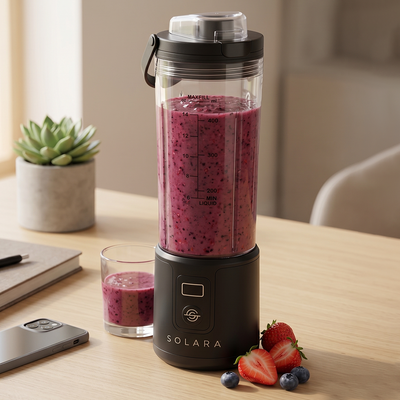


A portable blender is a small, battery-powered blender where the jar is also the bottle you drink from. That one design decision is the whole product: nothing to decant, nothing to wash up, and it works wherever you are rather than wherever your kitchen is.
It is also frequently oversold. Here is what it genuinely does, what it does not, and how to tell whether you need one.
What it is actually for
- Protein shakes. The single most common use, and the one it does best — a shaker bottle leaves lumps; a blender does not.
- Fruit smoothies. Banana, mango, berries, curd, milk or plant milk.
- Travel and office. A hotel room or a desk drawer is exactly where a mixer grinder is not.
- Baby food purees in small batches.
- One-portion drinks without dragging out and washing a full-size jar.
Notice the common thread: soft ingredients and liquid, in single servings. Stay inside that and it performs well.
Five things to check before buying
- Blends per charge, not battery size. mAh figures are marketing. What matters is how many blends you get before recharging — 15 is thin, 20–25 is a genuinely useful week of shakes.
- Charging port. USB-C is now standard and worth insisting on. Micro-USB means carrying a second cable.
- Blade count and material. Stainless steel, and enough blades to create a vortex rather than just spin liquid. Four or six is typical.
- A real safety lock. It should refuse to run unless the bottle is sealed and seated. This is a spinning blade you carry in a bag — do not compromise here.
- Bottle material and capacity. BPA-free plastic or borosilicate glass. Around 300–500 ml is the practical sweet spot; bigger stops being portable.
What a portable blender cannot do
Being straight about this saves disappointment:
- Crush hard ice. Most portable blenders struggle badly with solid ice cubes. Use crushed ice, small chips, or frozen fruit instead. Forcing whole cubes is the fastest way to burn out a small motor.
- Dry grinding. No masala, no coffee beans, no dry spices. There is no liquid to move the load, and the blades are not built for it.
- Chutney, batter or wet grinding. That is mixer grinder territory.
- Large batches. One serving at a time, by design.
- Thick, low-liquid mixes. Without enough liquid the blades spin in a cavity and nothing moves.
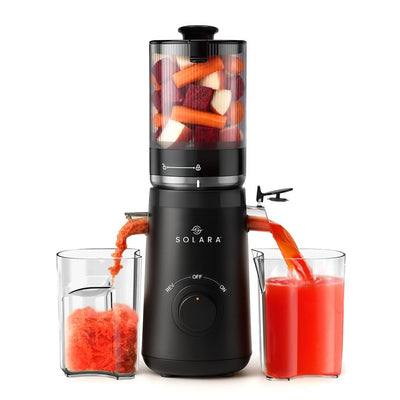
If any of those are what you actually need, buy a mixer grinder. If you want juice with the fibre removed rather than a smoothie, that is a different appliance again.
Getting a smooth blend every time
- Liquid first, always. Pour the milk, water or curd in before the solids. This is the fix for the single most common complaint.
- Soft ingredients next, frozen last.
- Do not fill past the max line. Blending needs headroom to circulate.
- Cut fruit small. Roughly 2 cm pieces — a small motor cannot pull down a whole banana.
- Pulse, then invert and shake if anything sticks, rather than running it continuously.
- Give it a rest between back-to-back blends so the motor stays cool.
Cleaning takes 20 seconds
Fill it a third of the way with warm water, add one drop of dish soap, run a short cycle, then rinse. Do it straight away — dried protein powder is far harder to shift than wet. Never submerge the motor base.
SOLARA BlendKwik Pro — USB rechargeable, 20 to 25 blends per charge, stainless steel blades, and it blends in the bottle you drink from.
So is a portable blender worth it?
Yes, if you make protein shakes or smoothies regularly, travel or commute, live alone or blend single servings, or simply will not use something that means washing a full-size jar.
No, if you want to grind masala, blend for a family, crush ice for cocktails, or already make smoothies in a mixer you are happy with. It is a convenience appliance, and its value is entirely in whether that convenience changes how often you actually use it.
Frequently asked questions
Are portable blenders any good?
For smoothies, protein shakes and single-serve drinks, yes — genuinely good. For anything hard, dry or large-batch, no. Judge one against a shaker bottle, not against a mixer grinder.
Can a portable blender crush ice?
Most cannot handle solid cubes. Use crushed ice or frozen fruit, and always add liquid first.
Can I grind masala or coffee in it?
No. Portable blenders are built for wet blending only. Dry grinding will damage the motor and blades.
How many blends per charge should I expect?
A good unit gives 20–25 blends of soft ingredients on a full charge. Frozen or dense mixes drain it faster.
Is it safe to carry in a bag?
If it has a proper safety lock that prevents it running unsealed, yes. Carry it empty and clean, not full.
Portable blender or mixer grinder?
They solve different problems. A mixer is the kitchen workhorse for grinding and batter. A portable blender is for one drink, made wherever you are, with nothing to wash. Many households sensibly own both.
