












A cold press juicer earns its place through the things a mixer cannot handle — leafy greens, ginger, wheatgrass, dense root vegetables. But yield depends far more on how you prep and feed than on the machine. Here is the ingredient-by-ingredient version.
What juices brilliantly
| Produce | Prep | Notes |
|---|---|---|
| Carrot | Top and tail, cut to fit | High yield, sweet base for almost any mix |
| Beetroot | Peel, quarter | Intense — use as a quarter of the mix, not the whole |
| Apple | Core, cut in wedges | The universal sweetener; balances bitter greens |
| Orange / sweet lime | Peel first | Rind is bitter and oily — it will taint the batch |
| Cucumber | Cut lengthways | Very high water content; great for diluting strong juices |
| Pineapple | Peel, core, chunk | Excellent yield, strong flavour |
| Pomegranate | Arils only | Deseed first; the pith is bitter |
| Celery | Cut into 2–3 inch pieces | Long strings can wrap the auger — always cut short |
Leafy greens and wheatgrass
This is the reason to own a slow juicer at all — a mixer yields almost nothing from spinach, and a fast centrifugal juicer barely does better. An auger presses greens properly.
- Roll leaves into a tight bundle before feeding. Loose leaves ride over the auger instead of being pulled in.
- Sandwich greens between hard produce. Feed carrot, then greens, then apple — the hard pieces push the soft ones through and clear the screen.
- Wheatgrass needs slow feeding. A small pinch at a time; forcing a handful in will bind the auger.
- Palak, methi, pudina, kale and coriander all work. Expect modest volume — greens are mostly fibre.
Ginger, turmeric and amla
Dense, fibrous and genuinely unpleasant to strain from a blender, which makes them a slow juicer's strongest case.
- Ginger: no need to peel if it is clean and fresh; a thumb-sized piece is plenty for a litre.
- Raw turmeric: juices well, and stains everything it touches. Rinse parts immediately, and expect some yellowing on plastic over time — it is cosmetic.
- Amla: deseed first. The stone is hard enough to damage an auger.
- For shots, juice these with a little apple or lemon — neat ginger juice is very intense.
What not to put in a cold press juicer
- Banana, mango, chikoo, avocado, papaya. Soft, pulpy fruit has no free juice to press — it just clogs the screen. Blend these instead.
- Stones and hard pits. Mango, peach, plum, amla seeds. Remove them; they can crack an auger.
- Coconut. Too hard and too oily for a domestic juicer.
- Sugarcane. Worth being blunt: a household cold press juicer is not built for sugarcane. It needs a dedicated crusher with steel rollers. Feeding cane into a domestic juicer risks the machine.
- Anything frozen. Thaw first.
- Whole citrus with rind, as above.
Six ways to get more juice
- Feed slowly. The single biggest factor. A slow juicer is designed to be fed at the rate it can press — pushing hard reduces yield and strains the motor.
- Alternate soft and hard. Hard produce clears the screen and pushes soft pulp through.
- Cut to fit the chute. Oversized pieces jam; over-small pieces slip past unpressed.
- Chill your produce. Cold, firm fruit presses better than room-temperature soft fruit.
- Re-juice the pulp once. On dense mixes, a second pass often yields another 10–15%.
- Cut long fibres short. Celery, wheatgrass and stalks wrap the auger otherwise.
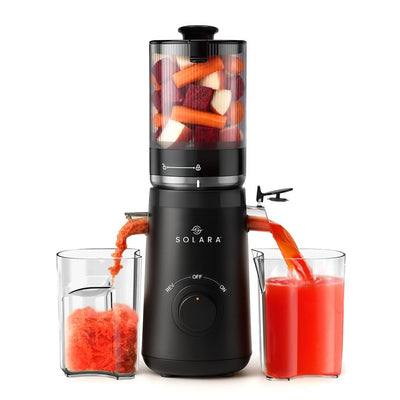
The SOLARA Cold Press Juicer runs slow and quiet, handles leafy greens, ginger and turmeric, and comes apart for cleaning in minutes.
Cleaning it in two minutes
Cleaning is the reason juicers end up in cupboards, so make it a habit rather than a chore:
- Rinse immediately. Wet pulp rinses off in seconds; dried pulp needs soaking. This is 90% of the battle.
- Run water through it between juices if you are making more than one.
- Use the brush on the screen — that mesh is where pulp lodges, and a cloth will not reach it.
- Air-dry fully before reassembling, so nothing sits damp.
- Turmeric and beetroot staining on plastic parts is cosmetic. A little lemon juice lifts most of it.
Frequently asked questions
Can I juice sugarcane in a cold press juicer?
No. Domestic cold press juicers are not designed for cane, which needs a dedicated roller crusher. Attempting it risks damaging the auger and motor.
Can I juice bananas or mangoes?
No — they have no free juice and will clog the screen. Blend them into a smoothie instead, or blend and add to a juice afterwards.
Do I need to peel fruit before juicing?
Peel citrus always — the rind is bitter and oily. Apples, carrots, cucumbers and ginger can go in unpeeled if well washed.
How long does cold pressed juice stay fresh?
Best within a few hours. Because cold pressing introduces less heat and air, it holds up noticeably better than centrifugal juice — refrigerated in a filled, sealed container it is usually fine for up to 24 hours.
Why is my juice yield low?
Usually feeding too fast, pieces cut too large, over-ripe produce, or a clogged screen. Slow down, cut smaller, and clean the mesh.
Should I drink the pulp?
You do not have to, but do not bin it either — carrot and beet pulp works in parathas, soups, muffins and dals.
